Breathing Ruins: How Speculative Fiction Writers Turn Dying Worlds Into Emotional Architecture
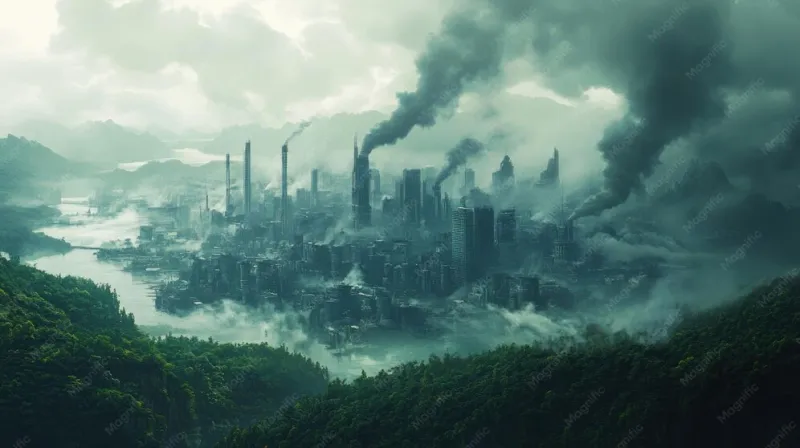
Photo: dystopian cityscape pollution haze atmospheric fog science fiction moody, via img.freepik.com
There is a particular kind of dread that accumulates slowly, the way particulate matter settles on a windowsill in a city that no longer regulates its air. The best speculative fiction understands this. It does not announce catastrophe with a thunderclap. Instead, it lets the atmosphere itself do the telling—the sallow light filtering through chemical haze, the rain that leaves residue on concrete, the silence where birdsong once lived. In the tradition of literary science fiction, the environment is never merely scenery. It is argument, emotion, and prophecy rendered in sensory detail.
At Vapor Trails, we have long believed that the most enduring speculative narratives are those in which the world breathes—or, more precisely, the ones in which readers feel the world struggling to breathe alongside its characters.
The Environment as Psychological Instrument
Consider what environmental decay accomplishes on the page that no expository passage can replicate. When a character steps outside and tastes copper in the air, or watches a sunset rendered lurid and gorgeous by atmospheric pollutants, the reader absorbs a complex emotional truth without being told what to feel. This is the foundational principle behind what craft scholars sometimes call atmospheric worldbuilding: the deliberate construction of mood through environmental specificity.
Jeff VanderMeer's Southern Reach trilogy remains a landmark study in this technique. The wilderness of Area X is not simply strange—it is wrong in ways that register viscerally before the intellect catches up. VanderMeer once described his process as attempting to render a landscape that felt like a half-remembered dream, one whose beauty and menace were inseparable. The result is an environment that functions as a character with its own agency, its own desires, its own capacity to wound.
This approach draws from a long lineage. Ursula K. Le Guin's ice-locked Gethen in The Left Hand of Darkness shaped not only the plot but the philosophical temperature of the entire novel. The cold was never incidental. It was the argument.
Weather as Narrative Voice
Emerging authors working in the speculative tradition today are pushing this technique further, using meteorological phenomena as a kind of free indirect discourse—a way of externalizing interior states without resorting to direct psychological exposition.
Take the growing body of cli-fi, or climate fiction, that has proliferated among American literary presses in the past decade. In these works, weather systems carry the weight of moral reckoning. A hurricane is not merely a hurricane; it is the accumulated consequence of a century of decisions rendered as atmosphere. The storm does not symbolize grief—it is grief, distributed across a geography.
Authors working in this space frequently describe a deliberate sensory layering process. Before drafting environmental passages, many compose what might be called a sense inventory: cataloguing not only what a degraded landscape looks like, but what it smells like in the early morning versus late afternoon, what it sounds like when wind moves through structures that were never designed to outlast their era, what the quality of silence means in a place where ecosystems have collapsed.
This granular attention to sensory register is what separates atmospheric worldbuilding from mere description. Description tells you a place exists. Atmosphere tells you what it costs to exist within it.
The Haunting Mood and Reader Investment
There is a psychological mechanism at work in readers who return obsessively to dystopian narratives—and it is not, as critics sometimes suggest, a simple appetite for despair. Research in narrative psychology points toward something more nuanced: readers seek environments that validate the ambient anxieties of contemporary life. A fictional world in the process of atmospheric collapse offers a kind of controlled container for fears that, in ordinary life, lack shape or resolution.
This is why the mood in speculative fiction matters as much as the plot. Readers do not merely want to know what happens in a dying world. They want to inhabit the emotional texture of that world long enough to process something they cannot otherwise articulate. The haunting quality of the best atmospheric science fiction—that quality that lingers in the mind like the smell of rain on hot asphalt—is not an aesthetic accident. It is the primary delivery mechanism for the work's emotional payload.
Cormac McCarthy's The Road, while operating outside the genre's conventional boundaries, demonstrated this principle with devastating clarity. The novel's ashen, colorless world was constructed with such precise sensory economy that readers reported experiencing a sustained low-grade grief throughout their reading—a grief that was not simply for the characters but for something they could not quite name. That unnameable quality is the signature of atmospheric worldbuilding executed at its highest register.
Pollution, Decay, and the Grammar of Loss
Pollution presents a particular opportunity for speculative writers because it operates across multiple registers simultaneously. Visually, chemically, biologically—degraded air and water alter every sensory experience of a place. More importantly, pollution carries an inherent temporality. It accumulates. It is evidence of what came before, a kind of sedimentary record of human decision-making written into the landscape itself.
Speculative fiction that uses pollution thoughtfully does not simply deploy it as shorthand for dystopia. It reads pollution's grammar: the way certain toxins produce specific colors, the way contaminated water tables affect the plants that grow above them, the way communities adapt their daily rhythms around environmental hazards until those adaptations become invisible, normalized, part of what it means to live in a particular place.
This level of research-backed specificity is increasingly characteristic of the most ambitious work being published in the genre today. Authors are consulting environmental scientists, studying EPA reports, reading oral histories from communities adjacent to Superfund sites. The result is a speculative fiction that feels less like extrapolation and more like recognition—which is, perhaps, the most unsettling achievement atmospheric worldbuilding can accomplish.
The Vapor and What It Carries
The great atmospheric narratives of speculative fiction share a common understanding: the air between characters is never empty. It carries history, consequence, and the slow arithmetic of ecological debt. When writers commit to rendering that air with precision—its temperature, its taste, its quality of light—they create something that transcends genre. They create an experience that readers carry with them into their own weather, their own mornings, their own sense of what the world outside their window is quietly becoming.
For readers seeking that experience, and for writers working to create it, the principle is consistent across every tradition the form has produced: the environment does not merely frame the story. In the hands of a skilled practitioner, it is the story—told in the language of sensation, accumulation, and the slow, beautiful weight of things in the process of ending.