Atomic Dreams Revisited: How Mid-Century Futures Are Reshaping the Way We See Tomorrow
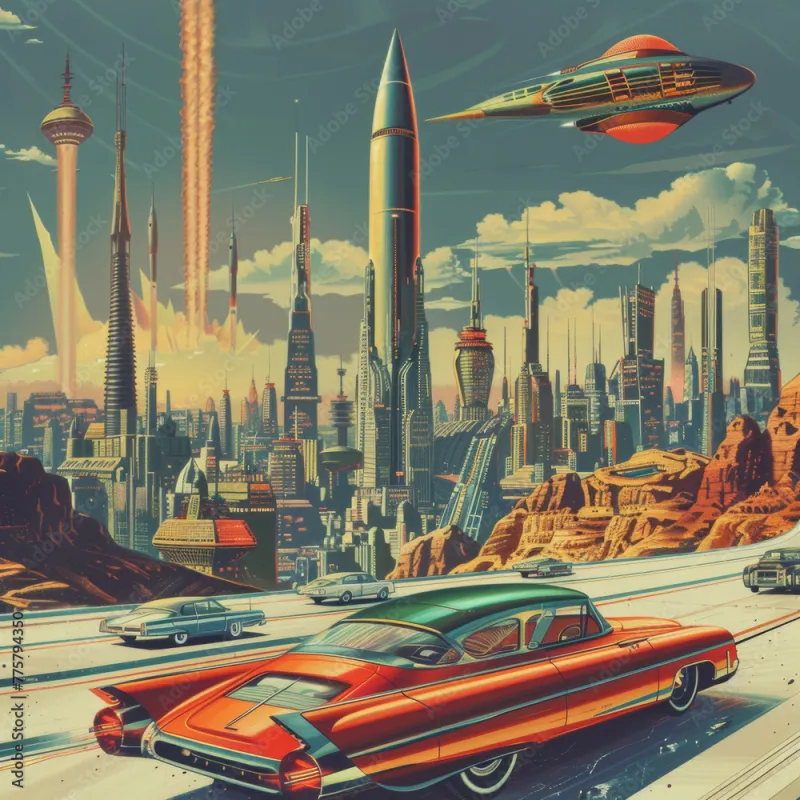
Photo: retro futuristic 1950s space age rocket city concept art vintage science fiction, via as2.ftcdn.net
Somewhere between the anxieties of the present and the nostalgia for a future that never quite arrived, retrofuturism has quietly become one of the defining aesthetic movements of American popular culture. The visual grammar of the 1950s — its streamlined automobiles, its bubble-helmeted astronauts, its cheerful faith in the redemptive power of nuclear energy and domestic appliance — has migrated from vintage paperback covers into the mainstream with a persistence that demands examination.
This is not mere nostalgia, though nostalgia is certainly part of it. Something more complex is occurring. We are, as a culture, returning to a specific historical moment's vision of the future at a time when our own future feels increasingly difficult to picture with any confidence. The question worth asking is not simply why retrofuturism is popular, but what its popularity reveals about the particular character of our present unease.
The Aesthetic Returns
The evidence of the revival is extensive. Amazon's Fallout series, adapted from the beloved video game franchise, brought its mid-century atomic aesthetic to one of the most-watched streaming debuts of 2024, introducing a vast new audience to the genre's visual vocabulary. Apple's design language, for years defined by minimalist austerity, has incorporated curves and warmth that echo the optimistic industrial design of the postwar era. Fashion houses from New York to Los Angeles have staged collections built around the silhouettes and color palettes of the Space Age — the cinched waist, the geometric print, the metallic fabric that suggests a rocket's skin.
In speculative fiction publishing, the influence is equally visible. A wave of novels and short story collections has engaged directly with mid-century science fiction's conventions — not as pastiche, but as a mode of critical inquiry. Writers are returning to the aesthetic frameworks of that era precisely because those frameworks carried assumptions about race, gender, and American exceptionalism that remain unresolved. To revisit the 1950s vision of tomorrow is, in many of these works, to excavate a set of promises that were made to some Americans and systematically withheld from others.
What the Atomic Age Promised
To understand why that era's futures retain such imaginative power, it helps to recall what they actually contained. The science fiction of the 1950s — produced in pulp magazines, early television, and the paperback originals that filled drugstore spinner racks from Maine to California — was characterized by a peculiar combination of technological triumphalism and existential dread. The same decade that gave America Forbidden Planet and the gleaming optimism of the 1958 World's Fair also gave it civil defense drills and the Doomsday Clock.
This internal tension — the coexistence of utopian aspiration and apocalyptic anxiety within a single cultural moment — is precisely what makes that era's futures so resonant today. We recognize the tension because we are living inside a version of it. The present moment is similarly bifurcated: extraordinary technological capability exists alongside profound uncertainty about whether that capability will be directed toward human flourishing or human harm.
Retrofuturism, viewed through this lens, is not an escape from contemporary anxiety. It is a way of processing that anxiety through the medium of a historical analogue that feels both distant enough to examine and close enough to feel.
Nostalgia as Critical Practice
Not all retrofuturism operates with the same degree of self-awareness, and the distinction matters. There is a version of the aesthetic that functions primarily as comfort — a retreat into a vision of the future that was simpler, more confident, and (for certain Americans) more hospitable. The chrome and the optimism serve as a kind of emotional shelter from a present that feels too complicated to navigate.
But the more interesting work being done within this revival treats the mid-century future not as shelter but as subject. Novelists like Colson Whitehead, whose The Intuitionist engaged with retrofuturist aesthetics to examine the racial politics of modernization, or the writers working in the tradition of Afrofuturism who have consistently interrogated whose future the Space Age was actually imagining — these voices use the genre's visual and narrative conventions as a kind of critical lens.
The question these works implicitly pose is a sharp one: when we look back at the gleaming futures of the 1950s, who do we see living in them? The answer, in the original material, was frequently a very narrow slice of American humanity. The revival, at its most thoughtful, is an act of revision — a reclamation of those futures for the people they excluded.
When Old Visions Catch Up
There is another dimension to this conversation that deserves attention: the strange phenomenon of mid-century predictions that have, in certain respects, proven accurate. The 1950s imagined video calls, handheld communication devices, and automated domestic labor. It imagined a world in which information would move at speeds that seemed fantastical. These predictions have, in their broad outlines, materialized — though never in the forms or with the consequences that the original visionaries anticipated.
This partial accuracy creates a peculiar temporal dislocation. We live in a world that resembles the 1950s future in some respects and bears no relationship to it in others. The smartphone in every pocket fulfills the promise of the communicator; the persistence of structural inequality, climate instability, and social fragmentation suggests that the techno-optimists were imagining the hardware without adequately imagining the software of human nature and political will.
The Trail Behind and Ahead
Retrofuturism's resurgence ultimately reflects something that speculative fiction has always understood: the future is never a blank screen onto which we project pure possibility. It is always shaped by the fears and desires of the present moment, which are in turn shaped by the accumulated weight of the past. The 1950s futures we keep returning to are not simply historical curiosities. They are vapor trails — evidence of a specific cultural velocity, a set of aspirations and anxieties that left a mark on the atmosphere.
Reading those trails carefully, as contemporary speculative fiction at its best is learning to do, is not an act of nostalgia. It is an act of orientation. To understand where a trail has been is to understand something essential about where it might be going.